

80% Student Engagement in Basic Mathematics with Kung Fu Quiz: A University Lecturer's Study


Student Engagement is one of the biggest challenges educators face, particularly in subjects that require sustained attention and active participation. A recent study by university lecturer Refni Adesia Pradiarti explored the use of interactive videos created with Kung Fu Quiz to increase student engagement in Basic Mathematics.
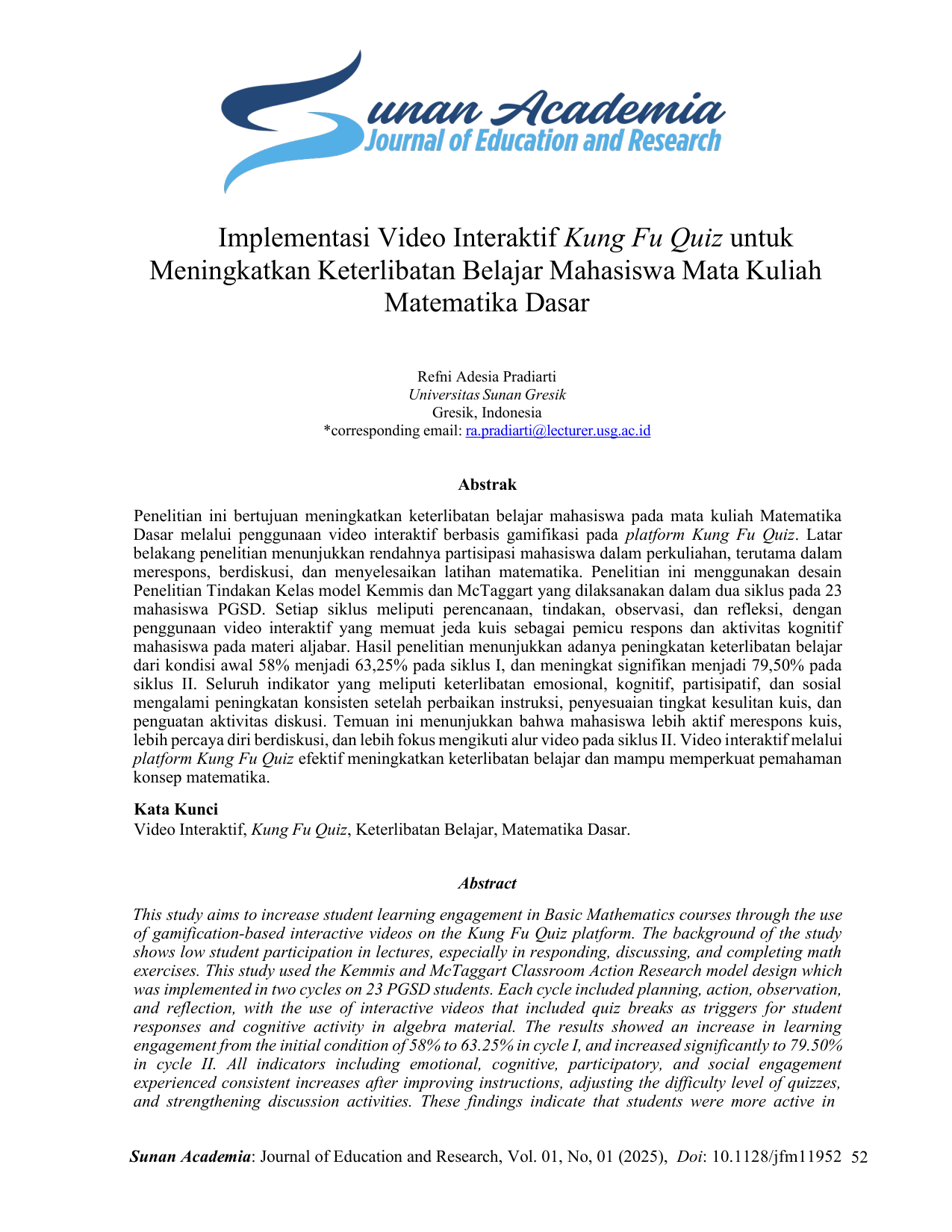
The peer-reviewed classroom study, published in Sunan Academia: Journal of Education and Research, used Kemmis & McTaggart’s two-cycle Classroom Action Research Model with 23 PGSD (Primary Teacher Education) students at Universitas Sunan Gresik. Conducted face-to-face, the study covered Algebraic Concepts and Operations embedded in video quizzes, and measured engagement across four indicators: Emotional, Cognitive, Participatory, and Social.
Passive Learning in Mathematics
Before the study, students learned through conventional lecture methods. The baseline student engagement score was only 58%, categorised as Fair.
The gap was visible as students were asked to respond to questions or discuss algebraic concepts. Participation was low, not because understanding maths was too hard, but because there was no real way for students to take part in the lesson beyond listening.
That's the pattern with traditional lectures and standard educational videos. Students simply watch without actively retaining information, and as a result, they lose focus, disengage from discussions, and struggle with conceptual understanding.
Using Interactive Video Quizzes to Improve Engagement
The study introduced students to the interactive video quizzes from Kung Fu Quiz. Both cycles followed the same pattern: students were introduced to the concepts of algebra, watched videos integrated with gamification-based interactive quizzes, opened the floor for group discussions, and then worked through simple algebra exercises together.
This new approach turned passive learning students into active learners. Instead of just watching lessons, students were:
- Answering questions during the lesson
- Competing on leaderboards
- Discussing answers in groups
- Thinking critically while watching the content
Student engagement in Basic Mathematics increased to 63.25% after the first cycle, representing a significant improvement. Based on these results, the video instructions were refined, quiz difficulty was adjusted, and classroom discussion time was managed. These changes increased student engagement to 79.50% in the second cycle.
This improvement was measured across four engagement indicators:
- Social Engagement: Increased from 61% to 81% as students became more active in classroom discussions and peer interaction.
- Emotional Engagement: Rose from 65% to 80%, reflecting stronger enthusiasm, focus, and readiness to learn.
- Participatory Engagement: Improved from 61% to 79%, with students contributing more consistently throughout lesson activities.
- Cognitive Engagement: Increased from 62% to 78%, showing stronger critical thinking and problem-solving during mathematics learning.
A Small Change with a Big Impact
This study highlights an important lesson for educators worldwide: boosting engagement does not always require a full course redesign. Sometimes, the most effective changes come from transforming existing learning materials into interactive learning experiences.
Interactive Videos are effective because they break the passive-learning habits. A quiz in between the video encourages students to actually process what they have just learned rather than simply watch and move on. This helps students stay focused and improve understanding.
Especially when studying maths, students can easily disengage during long explanations. Through interactive video quizzes, students are encouraged to apply concepts they’ve just learned, turning lessons into a more active and collaborative learning experience.