

Leading with Innovation: Reimagining Entrepreneurship Education for the Modern Learners

Entrepreneurship cannot be taught through theory alone. A student who memorises the stages of a business model canvas but has never had to decide whether to sell a product through a TikTok Shop or a weekend pop-up booth, or who has never had to pivot an idea after hearing a customer say "no", is simply a student who knows about entrepreneurship, not one who has experienced it.
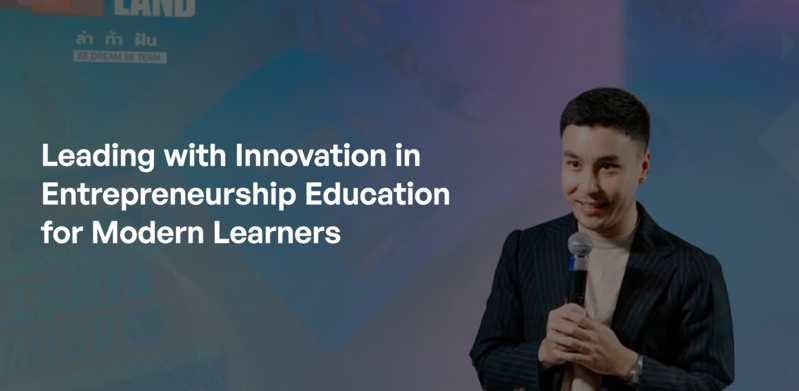
As the Director of the Entrepreneurship and Creative Innovation Program at Sripatum University, Bangkok, Thailand, I believe learning should reflect real-world thinking. My work focuses on designing learning experiences that immerse students in the entrepreneurial journey, decision-making, and active engagement with ideas that mirror the reality of growing a business. Our role as educators is not simply to deliver content but to create an environment where students can discover opportunities, test ideas, learn from failure, and develop the confidence in making decisions.
Simulating the Real-world Entrepreneurship in Classrooms
Real entrepreneurial thinking and decision-making happen under pressure, with incomplete information, quick adaptations, and learning from outcomes. Our program is built around the experiences that mirror reality through project-based learning, business simulations, digital platforms, startup-style pitching, industry-linked assignments, and collaboration with entrepreneurs, industry partners, and business professionals, enabling students to connect academic knowledge to the real world.
These approaches help students develop business knowledge with confidence, creativity, resilience, and practical judgement. Students are not walking into the class for lectures, but are immersed in situations they have to tackle. Our assessments reflect this by becoming opportunities for students to prepare for real market expectations and professional practice.
For instance, a marketing strategy quiz can be turned into a simulated campaign. Students must decide whether a new product should be sold through TikTok Shop, Shopee, LINE Official Account, university pop-up booths, local cafés, or convenience-store-style channels, and justify their choice based on customer behaviour in Bangkok, market conditions, and operational constraints to refine the business model accordingly. The question is: "Given what you know about your customer, where do you sell and why?" These practical scenarios help students understand how business decisions are made in Thailand’s fast-changing markets.
Using EdTech and AI to enhance the Teaching Methods
The university uses an integrated e-learning platform that combines learning materials, assignments, quizzes, discussions, feedback, grading, and learning analytics. Students document their entrepreneurial journey in the platform, from opportunity discovery and market research to idea validation, business model development, and pitching.
Additionally, the platform supports a flipped classroom model, where students can learn from the video lessons, additional reading materials, digital assessments, automated quizzes, discussion forums, and learning analytics before class. This allows the instructor to move from content delivery to coaching, where students apply what they have learned to real entrepreneurial situations.
AI has also become a natural part of how students work. For activities like online business case analysis, AI tools are used by students to brainstorm product ideas, develop customer personas, research and compare competitors in the Thai market, draft survey questions, summarise customer feedback, or improve marketing messages for platforms such as TikTok, Shopee, LINE Official Account, or local pop-up sales channels. At the same time, educators are exploring technologies that improve both teaching effectiveness and student engagement. AI tools assist in generating diverse question banks, enabling faculty to focus more on mentoring, guiding, and facilitating meaningful discussions.
One example is Kung Fu Quiz, which helps create dynamic and engaging learning experiences for university students. When a faculty member at Sripatum University was introduced to the platform, the potential became immediately apparent. By turning assessments into live quizzes, the platform gave the instructor a practical way to encourage participation and spark classroom discussion. Innovative tools like this reflect exactly the kind of innovation that modern educators are looking for.
Student Engagement and Motivation Strategies
Student engagement is strongest when students discover their capabilities. In the Entrepreneurship and Creative Innovation Program, students are encouraged to identify real market opportunities, understand consumer pain points, test ideas, interact with customers, and generate income through practical projects. This makes learning more active, meaningful, and directly connected to business reality.
One successful strategy has been opportunity-based learning, where students have turned real market problems into business ideas, applying classroom frameworks to test, refine, and eventually launch ventures.
Our students and graduates have built both online and offline businesses across the pet industry, food and beverage, hospitality, and creative services. This shows that what started as an idea in the classroom has been successfully tested in markets. Students are not only learning theories, but also applying them to create real value for customers.
The program further motivates the students through pitching, market testing, pop-up selling, and mentorship from industry professionals. This approach helps students understand entrepreneurship as a journey of opportunity finding, action, reflection, and continuous improvement. That progression from theory to action to outcome is what the Entrepreneurship and Creative Innovation Program is all about.
Shaping the Forward-Thinking Education
The work at Sripatum University reflects a broader transformation taking place across higher education. Effective teaching is no longer defined by how much content is delivered. Instead, it is measured by how deeply students are engaged and how effectively they apply their knowledge in a real-world context.
This shift is particularly important as digital platforms, consumer behavior, and business tools evolve rapidly. Students must develop their ability to continuously learn and adapt across areas such as social media channels, AI tools, online marketplaces, and emerging technologies in today’s fast-changing world.
For entrepreneurship students, digital adaptability is no longer optional; it is a part of how opportunities are discovered, tested, and scaled. As educators and leaders, it is our responsibility to experiment, adapt, and innovate to shape the future of learning for students.