

82% of Students Achieved History Learning Mastery After Using Kung Fu Quiz, Study Finds


What happens when an interactive quiz becomes part of a classroom lesson?
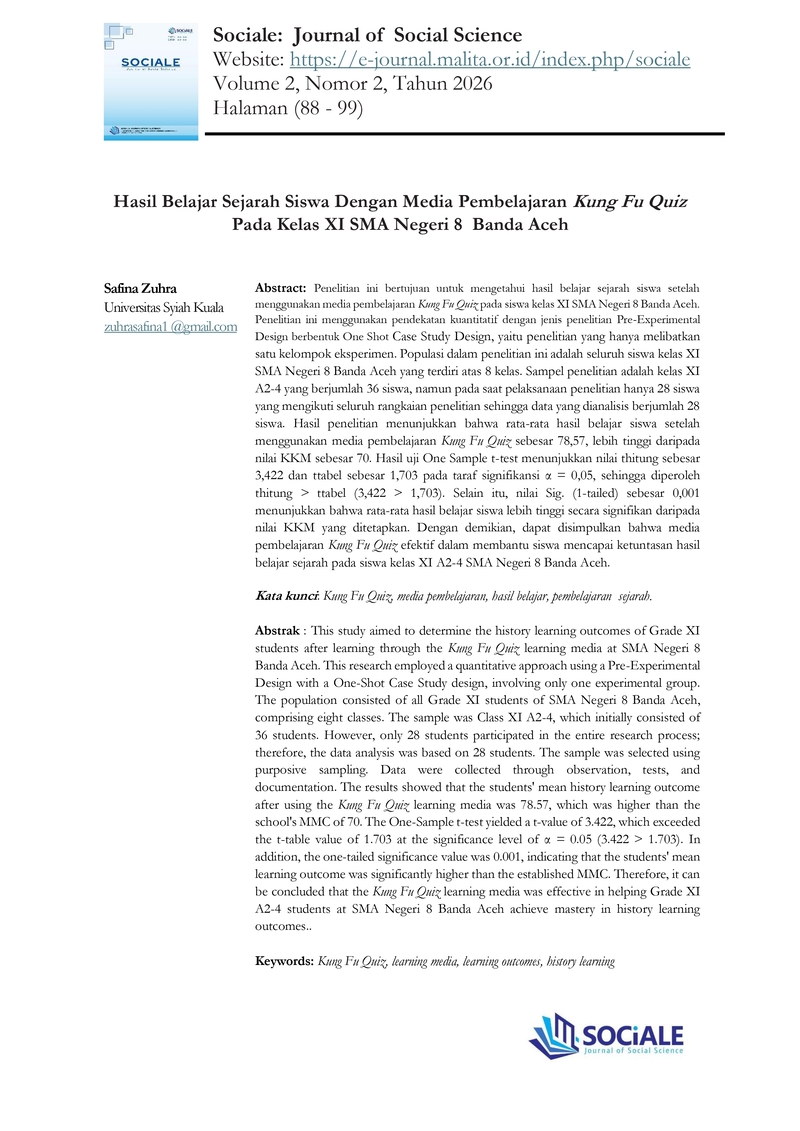
A recently published study from Indonesia examined the History learning outcomes of Grade XI students after a lesson using Kung Fu Quiz. Of the 28 students who completed the study, 23 students, or 82.14%, achieved the school’s Minimum Mastery Criterion.
The study, conducted by Safina Zuhra of Universitas Syiah Kuala Banda Aceh, was published in Sociale: Journal of Social Science in July 2026. It explored the use of Kung Fu Quiz alongside the Student Teams Achievement Division (STAD) cooperative learning model at SMA Negeri 8 Banda Aceh.
The findings offer a useful classroom example of how interactive, quiz-based learning can support participation, assessment and measurable learning outcomes.
The Study at a Glance
- School: SMA Negeri 8 Banda Aceh, Indonesia
- Participants: 28 Grade XI students
- Subject: History
- Lesson topic: The End of the Japanese Occupation in Indonesia
- Learning approach: Kung Fu Quiz combined with the STAD cooperative learning model
- Assessment: A 10-question multiple-choice post-test
- School mastery benchmark: 70
- Average student score: 78.57
- Students who achieved mastery: 23 out of 28, or 82.14%
Before the research was conducted, the school’s existing test-score records showed that only 8 of 36 students, or 22.22%, had achieved the History mastery benchmark. The researcher identified several classroom challenges, including limited student participation, teacher-centred instruction and insufficient variety in the learning media being used.
Kung Fu Quiz was introduced as an interactive learning medium that could present lesson content, assess understanding and provide students with immediate feedback.
How Kung Fu Quiz Was Used in the Lesson
The teacher began by activating students’ prior knowledge, explaining the learning objectives and organising the class into groups. The History material was then presented through Kung Fu Quiz using a projector.
Students worked collaboratively to discuss the topic and complete worksheets. After the group activity, each student completed an individual quiz through Kung Fu Quiz to assess their understanding.
An observer evaluated whether the lesson followed its planned procedures. The implementation received a score of 94.44%, placing it in the study’s “Very Good” category. According to the study, students participated throughout the lesson—from the opening activities and group discussions to the individual quiz.
What Did the Study Find?
The students’ post-test scores ranged from 50 to 100, with an average score of 78.57. This was 8.57 points above the school’s Minimum Mastery Criterion of 70.
Of the 28 participating students:
- 23 students (82.14%) achieved mastery
- 5 students (17.86%) did not achieve mastery
Based on these results, the study concluded that the students’ average learning outcome after the lesson was significantly higher than the established school benchmark.
Read the Original Study
The original Indonesian-language article, “Hasil Belajar Sejarah Siswa Dengan Media Pembelajaran Kung Fu Quiz Pada Kelas XI SMA Negeri 8 Banda Aceh,” was written by Safina Zuhra and published in Sociale: Journal of Social Science, Vol. 1, No. 2 (2026), pp. 88–99.
Why These Findings Matter for Teachers
The value of an interactive quiz is not limited to making a lesson feel more enjoyable. When questions are built into the learning experience, students are prompted to respond, retrieve what they have learned and demonstrate their understanding.
In this classroom, Kung Fu Quiz supported a lesson that moved through several stages: teacher guidance, peer discussion, collaborative work and individual assessment. This gave students opportunities to engage with the History material before showing what they had understood on their own.
For teachers, this type of approach can help turn assessment into part of the learning process. Instead of waiting until the end of a unit to discover whether students understood the material, quiz responses can provide more immediate evidence of participation and comprehension.