

Level up your Quizzes using Higher-Order Thinking (HOTs) Questions

Interactive quizzes are common in classrooms. They help teachers quickly check what students remember, but too often they stop there. The real goal is not only to test memory, it is to spark creative thinking, encourage problem-solving, and deepen understanding. That is where Higher-Order Thinking Skills (HOTs)questions come in.
For example, if you ask, "What year was the peace treaty signed?" you test fact recall. But if you ask, "If those leaders met today, how would they change that treaty to address modern issues like climate change or cyberwar?" students must reason, evaluate, and create.
HOTs questions move beyond "what" and challenge learners to explain "why" and "how". Embedded into quiz formats, they transform routine assessments into active learning experiences.
In this blog, we explore what HOTs questions are, why they matter, and how teachers can use them with Kung Fu Quiz to help students think deeper instead of only memorising answers.

What are Higher-Order Thinking Skills (HOTs)?
Higher-Order Thinking Skills are more than simple recall. They require students to apply deeper reasoning and analysis. Instead of only asking "What happened?", HOTs questions ask "Why did it happen?" and "How can this idea be used in a new situation?"
HOTs aligns with upper levels of Bloom's Taxonomy: apply, analyze, evaluate, and create. The purpose is not only correct answers, but durable understanding that extends beyond exam settings.
When paired with quizzes, HOTs becomes engaging and measurable. Teachers can turn deeper thinking into classroom practice while still getting performance data through quiz insights.
Creating HOTs Quizzes with Kung Fu Quiz
Multimedia-rich interactive quizzes are powerful tools for integrating HOTs into everyday lessons. They make complex prompts easier to engage with while preserving academic depth.
Kung Fu Quiz helps teachers create HOTs-focused quizzes in a gamified format where students analyze, evaluate, and create. By combining visuals, audio, and real-time feedback, quizzes become active learning experiences instead of passive checks.
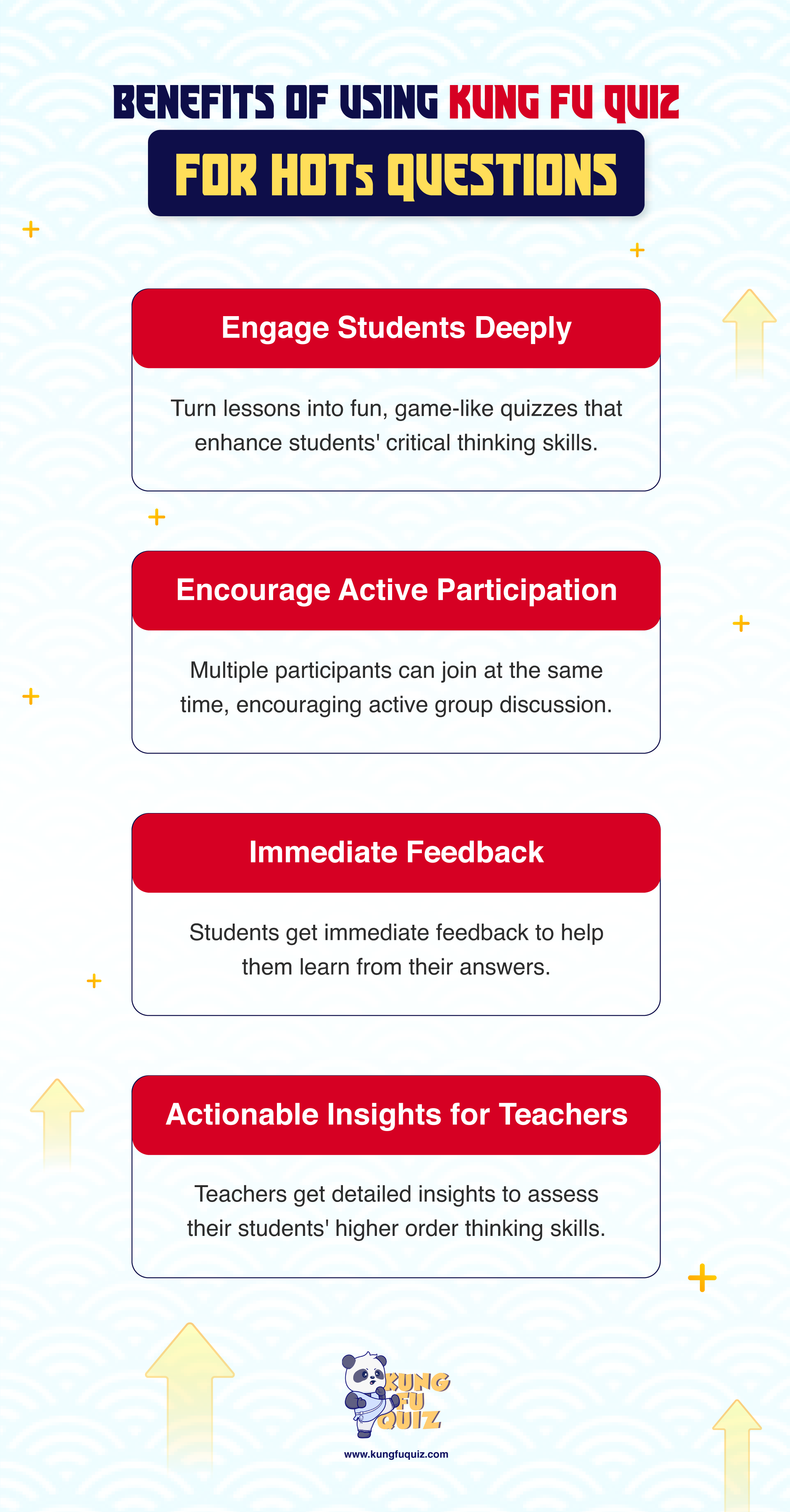
Benefits of using Kung Fu Quiz for HOTs Questions
- Engagement drives deeper thinking: Teachers can use visuals, audio, and scenario-based prompts that capture attention and encourage deeper reasoning.
- Encourages active participation: Students can play simultaneously and compare varied responses, which supports discussion, idea-sharing, and collaborative reasoning.
- Immediate feedback supports memory: Students do not only see right or wrong answers. They are pushed to reflect and reason immediately.
- Actionable insights for teachers: Reports reveal how students responded, where reasoning gaps appear, and which concepts need reteaching.


In summary, HOTs quizzes do not simply assess what learners know. They strengthen real-time reasoning while students refine their responses. Instead of choosing from fixed answers alone, students compare, predict, justify, and reflect.
Interactive and multimedia elements support multiple learning styles, improve engagement and retention, and align with 21st-century goals such as creativity, collaboration, and critical thinking.
Teachers can use HOTs-based online quizzes to spark meaningful discussions and encourage students to think beyond the obvious.
FAQs About Higher-Order Thinking Skills (HOTs)
What are Higher-Order Thinking Skills (HOTs)?
HOTs are advanced thinking processes like analysis, evaluation, and creation that go beyond memorising facts, helping students make connections and solve complex problems.
Why are HOTs important in education?
They develop critical thinking, creativity, and problem-solving skills that students need for academic success and real-world challenges.
How can teachers promote HOTs in the classroom?
By asking open-ended questions, using real-world scenarios, encouraging debates, and integrating interactive tools like Kung Fu Quiz.
What is the difference between LOTs and HOTs?
Lower-Order Thinking Skills (LOTs) focus on remembering and understanding, while HOTs require deeper thinking like analysis, evaluation, and creation.
Can HOTs be assessed in quizzes?
Yes. HOTs-based quizzes use prompts that require students to compare, justify, propose, or design solutions, often with multimedia and interactive formats.
Do HOTs benefit all types of learners?
Absolutely. They support different learning styles, foster engagement, and help all students build adaptable skills for the 21st century.