



How Do Interactive Quizzes Enhance Your Learning Journey
Published on 03 Feb, 2025
Think about the last time you truly remembered something you learned. Was it from quietly listening to a lecture or from actively doing something with the information?
That difference explains why passive learning often fades fast, while active learning sticks. That's where interactive quizzes come in. They aren't just a test or a fun addition, they're a proven strategy to help students retain information, stay engaged, and build critical thinking skills. Students who learn through active quizzes are nearly 3 times more likely to develop higher-level thinking skills than those in lecture-only classrooms.
Whether you're a student aiming to improve your exam scores, a teacher looking to boost classroom engagement, or an EdTech enthusiast, this blog helps you explore how interactive quizzes can enhance both teaching and learning experiences.
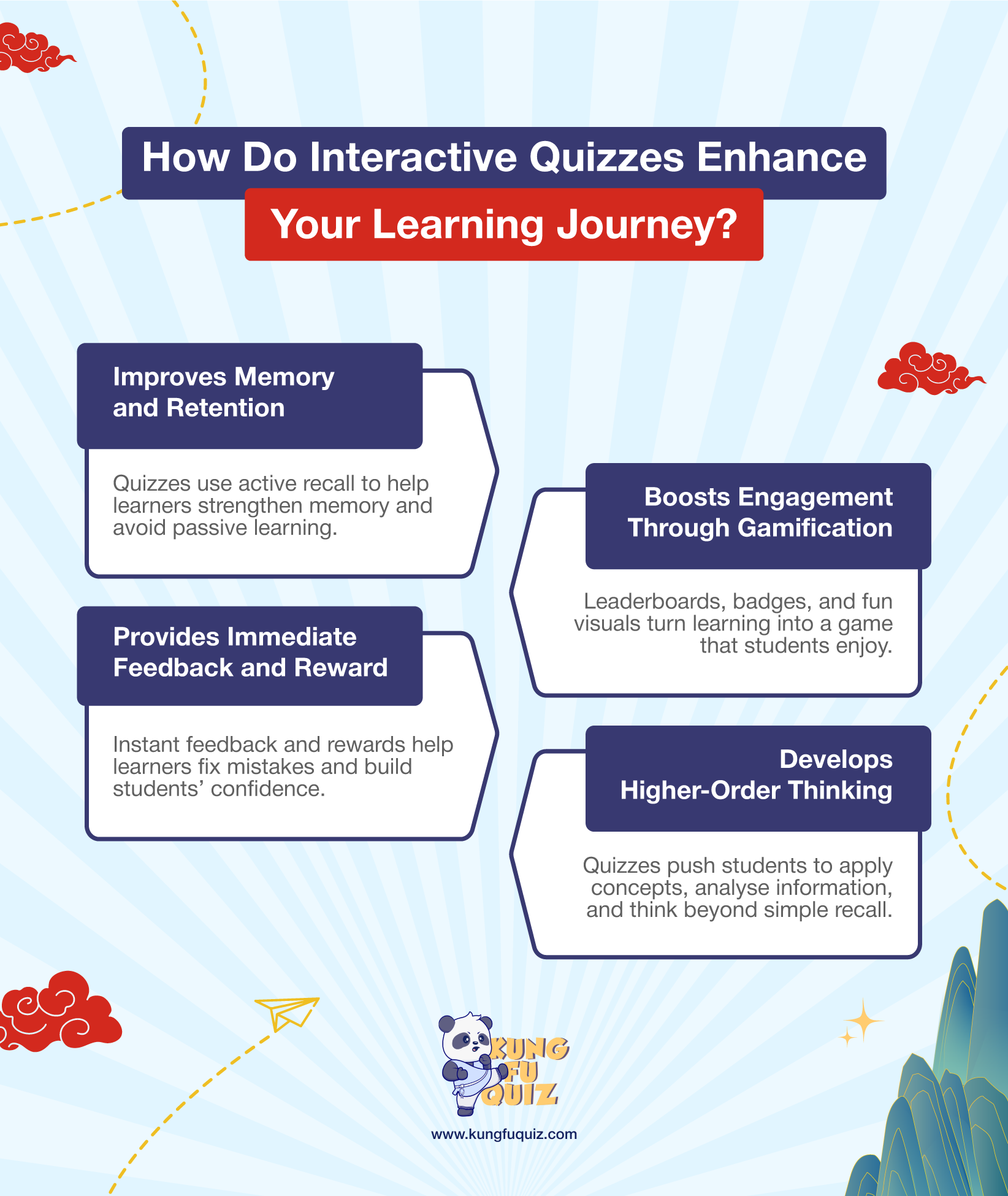
Improves Memory and Retention
One of the biggest advantages of interactive quizzes is their ability to boost knowledge retention. By actively engaging the brain, they make learning more effective than traditional methods, strengthening long-term memory and deepening understanding.
Active Recall and Spaced Repetition
Quizzes do more than just test knowledge, it strengthens retention through active recall. Instead of passively reading or listening, students retrieve information. When quizzes appear repeatedly over time, such as pop-up questions within a video, the brain relearns a topic. This process is known as spaced repetition.
A large cohort of students found that spaced repetition improved learning outcomes by more than 30%, compared to one-time review methods. By revisiting topics gradually through quizzes, they make learning more effective than last-minute cramming.
Enhances Long-Term Memory Storage
Quizzes help learners store information in long-term memory by engaging students inretrieval-based practice. Each time a student answers a question, neural pathways related to that concept are strengthened, making recall easier in the future. Repeated exposure to key topics through interactive quizzes reinforces learning over time, acting as a permanent storage for your short-term memory.

Boosts Engagement Through Gamification
Engagement plays a crucial role in effective learning, which is why many modern educators use gamified elements . These elements are widely favored by students and teachers to bring energy, competitiveness, and interactivity to the classroom.
Friendly Competition and Leaderboards
Who doesn't love a little competition? Gamified elements such as points, badges, and leaderboards encourage learners to focus, try harder, and actively participate throughout the learning process,making learning feel like a game instead of a chore.
Leaderboards that showcase top performers can spark healthy competition and accountability. Research on challenge-based gamification shows performance gains of over 34.75% compared to relying on traditional learning methods.
Interactive Elements for Immersive Learning
Interactive quizzes further enhance engagement through multimedia elements such as images, videos, audio clips, and varied question types. Whether it's drag-and-drop diagrams or video-based questions, these features keep learners mentally involved rather than passively listening. This significantly boosts students' attention span and improves understanding.
Provides Immediate Feedback and Reward
Timely feedback is crucial for effective learning, and interactive quizzes excel at delivering it in real time.
Instant Insights into Learning Progress
Beyond showing correct and incorrect answers, many platforms provide detailed insights into both individual and entire class performance. These insights help teachers identify the learning gaps, tailor practice, and make informed decisions. Platforms like Kung Fu Quiz strengthen teaching through data-driven quiz insights.
Additionally, immediate feedback helps students recognise and learn to correct mistakes, preventing misunderstandings from turning into habits.
Positive Reinforcement and Confidence Building
Gamified rewards such as points, badges, and encouraging messages reinforce students' effort and progress. This recognition builds confidence and keeps them motivated to continue. Even incorrect answers become valuable learning moments, encouraging persistence, improvement, and a growth mindset, often more effectively than traditional grading systems.
Personalises Learning Experiences
Every learner progresses at a different pace, and quizzes help tailor learning to individual needs.
Adaptive Difficulty Levels for Individual Learners
Adaptive quizzes are designed to support students' ability to learn at their own pace. It adjusts the question's difficulty levels based on their responses. For example, if a student struggles, the difficulty level simplifies, and if they perform well, the challenges increase.
This adaptive learning keeps students in an optimal learning zone, engaged without feeling bored or overwhelmed. Platforms like Duolingo and Quizlet demonstrate how adaptive learning learning supports steady progress and motivation.
Tailored Content for Targeted Learning Goals
Interactive quizzes can be customised to focus on specific skills or problem areas. Teachers can create topic-specific quizzes that reinforce students' strengths while addressing gaps.
For example, a learner struggling with algebraic equations can receive focused practice without revisiting unrelated topics, making learning more efficient and confidence-building.
Develops Higher-Order Thinking
Interactive quizzes go beyond memorisation by helping learners build critical thinking and problem-solving skills.
Critical Thinking and Problem-Solving Skills
Well-designed questions require students to apply, analyse, and evaluate information through high-order thinking (HOTs) questions, scenarios, case studies, and multi-step problems. For instance, problem-solving quizzes in mathematics or text analysis in literature encourage strategic thinking and real-world application rather than simple recall.
Promoting Analytical and Creative Thinking
Some quizzes also include open-ended or reflective questions that ask students to explain their reasoning. This promotes metacognition, helping students understand how they think, analyse patterns, and apply concepts creatively, leading to a deeper understanding.
Make Interactive Quizzes With Kung Fu Quiz
Ready to try interactive quizzes for your classroom? makes it easy to bring all classroom? Kung Fu Quiz makes it easy to bring all these benefits together in one powerful platform. It helps educators create interactive and engaging quizzes for classroom and remote learning. Teachers can turn YouTube videos into interactive lessons by embedding questions at any part of the video, before introducing a concept or after a key explanation, to promote active learning and instant feedback.
Beyond video quizzes, teachers can also add interactive elements like images and audio, and choose from six question types to suit different learning goals. Real-time insights, live leaderboards, and student insights make it easy to track progress and improve lessons. Teachers can also explore the ready-to-play quiz templates created by educators around the world, saving time while maintaining quality and consistency.
Whether for schools, colleges, or online learning platforms, Kung Fu Quiz empowers educators to make learning truly interactive, engaging, and effective.
Frequently Asked Questions (FAQs)
What Are Interactive Quizzes?
Interactive quizzes are digital quizzes that actively involve learners through different types of questions, along with videos, images, and audio. Unlike traditional quizzes, they provide instant feedback and encourage learners to think and respond while learning.
How Do Quizzes Help With Learning?
Quizzes improve learning by using active recall and retrieval practice. Answering questions helps learners remember information better, understand concepts more deeply, and identify areas they need to improve.
How To Do An Interactive Quiz?
To create an interactive quiz, choose a quiz platform like KungFuQuiz, add your questions, include images, audio, or videos if needed, and share the quiz with learners. You can also turn YouTube videos into interactive video quizzes by embedding questions directly into the video.
Do Students Who Complete Quizzes Perform Better Academically?
Yes. Research shows that students who regularly complete quizzes tend to score higher, retain information longer, and feel more confident in their understanding compared to students who rely only on lectures.
What Features Should I Look For In An Online Quiz Maker?
A good quiz maker should offer multiple question types, instant feedback, multimedia support, real-time performance tracking, and options to reuse or share quizzes with other educators.
How Interactive Learning Features Track Student Progress
Interactive platforms track data such as participation, accuracy, time spent on questions, and quiz completion. This helps teachers understand how students are learning and where they may need extra support.
What Are Some Good Quiz Sites?
Popular quiz platforms include Kung Fu Quiz, Kahoot, Quizizz, and Quizlet. KungFuQuiz stands out by allowing educators to create interactive video quizzes using YouTube videos and offering detailed real-time learning insights.
How Do Digital Quizzes Aid In The Learning Process?
Digital quizzes support active learning by keeping students engaged, providing instant feedback, and reinforcing concepts through repeated practice, which leads to better understanding and retention.
What Tools Enable Interactive Video Lessons With Embedded Quizzes?
Tools like KungFuQuiz allow teachers to embed questions directly into videos, turning passive watching into an interactive learning experience where students can answer questions as the video plays.